
Exhibitions
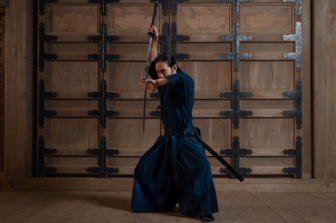
Dō – Spirit of The Way
The exhibition covers a wide range of Japanese arts that bear the suffix "dō" (道) which have shaped the cultural and spiritual landscape of Japan. Dō, which means "way," originates from the Chinese concept of Dao, which was integrated over generations into Zen Buddhism. Both traditions sought to understand the essence of the "way" as an inner and spiritual journey.
Saturday, 30.05.26
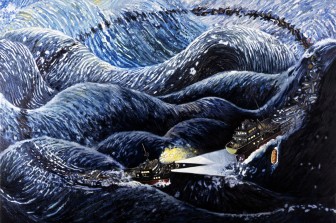
The Wave Effect - From a Japanese to Global Icon
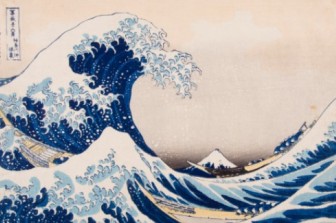
The concept of this exhibition touches on the three elements that make up the Great Wave -- wave, boats, and Mount Fuji. These elements are represented here in the works of Japanese and Israeli artists and are translated into the language of the period in which they were created. The element of the wave is examined through works in which it is a stylized force of nature, an ethereal boundary line, a metaphor for social isolation, and a representation of existential anxiety; not necessarily anxiety related to natural disasters. The element of boats between the waves is associated with works about war in Japanese art and with works dealing with personal and national assimilation in Israeli art. The element of the mountain appears in traditional Japanese works that emphasize different perspectives of the mountain, alongside Israeli artworks which express the attraction to the mountain. The exhibition also gives space to young artists who respond to the work using diverse visual means and in defiant and different ways.
Saturday, 07.06.25
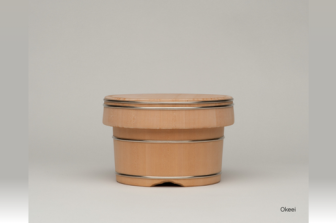
Japanese Design Today 100
"Japanese Design Today "100” was first developed in 2004 and then toured the world for the following decade. Now we present the third edition of the exhibition, which again brings together superlative examples of Japanese design from a present-day perspective. The exhibition is organized according to thirteen categories among them - furniture, electronics, health, communication, daily life, tableware and cooking, transportation, architecture. The exhibition includes approximately 100 items, most of which are products released after 2000, but it also includes several masterpieces from earlier times in which we can trace the roots of contemporary Japanese design. From objects such as consumer products to intangible systems and services, the designs we use in our daily lives speak volumes about the evolution of our lifestyles and society.
Saturday, 23.11.24
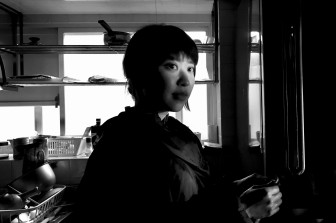
Light on Skin
At the age of 17, Michael Sela (born 1998) decided to become the best photographer in the world. Equipped with a Pentax film camera his father gave him, he embarks on a journey for the sole purpose of photography. This journey also takes place in Japan (2019), which becomes his home. Sela's photographs express sentimental and magical emotions at the same time. His photographs are a means of connecting with a different, distant Japanese reality, but which are also very intimate. He knows most of the people he photographs, and for him photography is capturing small moments in their midst. The people closest to him are photographed in a given space, because a photograph is a sliver of space as it is a sliver of time.
Saturday, 23.11.24
Japanese Sushi Girls
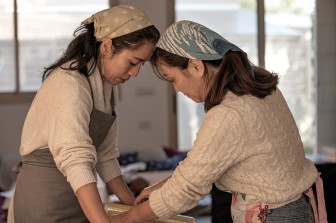
On Friday January 19, 2024, "Japanese sushi girls" (Kaori, Naomi A., Yuri, Mami Ari and Naomi S.) gathered to prepare sushi for the soldiers at the front. For two hours, they put rice on seaweed, peeled avocado, added carrot, omelet, and cucumber, rolled seaweed, and cut it. One packs it and another writes greetings to the soldiers. The act is not intended to satisfy the hungry but to pamper them, to provide food that they are skilled in preparing, and which they usually prepare for their families. While preparing the sushi, there was a harmony and order among them that charmed me. The coordinated actions, the delicate acrobatics of fingers moving gracefully on seaweed, and the understanding that prevailed between them in silence, laughter, and talk, were beautiful to me, as were the ironed aprons and the Japanese handkerchiefs they wore on their heads. Six women, six life stories full of decisions, fears and hopes. Among the decisions is the decision to live in Israel, far from their parents, their families, their people, and their country. They decided to tie their fate to the fate of my people and show solidarity at this difficult and complex time. Their actions draw together a thread of grace, kindness, and magic.
Saturday, 23.11.24
Duos
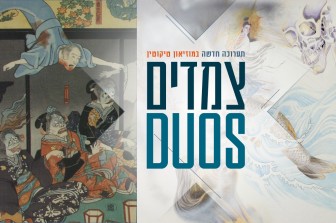
The "Duos" exhibition connects between traditional Japanese woodblock print artists and contemporary Japanese and Israeli artists. The first duo, Hiroshige X Tabaimo, is a connection between one of the greatest 19th century print artists, Utagawa Hiroshige, and the contemporary video artist Tabaimo. The second duo, Kuniyoshi X Kuperman, is a connection between the woodblock print artist Utagawa Kuniyoshi and the Israeli painter Ruven Kuperman. The connecting point of another duo, Hokusai X Balaban, is the aesthetics of images of warriors with a special emphasis on movement, and these are depicted in the warrior books of the artist Katsushika Hokusai and translated to the unique and refined language of the artist Yael Balaban.
Saturday, 25.05.24
Earth, water, wind, fire…and emptiness
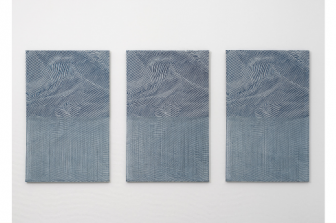
Earth, water, wind, fire... and space are the elements that make up the entire universe. They are part of an ancient doctrine that used them as a means of solving problems, and from that time they have been an inseparable part of a variety of disciplines - philosophy, art, medicine, astrology and even politics. The connection between the elements emphasizes the basic concept that they nurture each other and that every element in our world is mutually dependent on another and does not exist separately. This exhibition seeks to illuminate all five elements in the light of art and to present the interrelationships between them through the works shown.
Saturday, 18.11.23
Treasures of the Tikotin Museum of Japanese Art
On the celebrated occasion of the 60th anniversary of the Tikotin Museum of Japanese Art, a wide variety of artworks from the Museum’s collection will be displayed. It is one of the most important and fascinating collections outside Japan. The collection comprises mostly of Japanese artworks from the Felix Tikotin Collection, to which donations of private collections were added, among them, the collections of Lewis B. Gutman and Daniel and Hilda Lebow of New York, the collection of Abraham Horodisch of Amsterdam, the collections of Shulamith and David Rubinfien and Sandra and Kenneth Bleifer of California, the collection of Michael Rukin of Boston and many others.
Tuesday, 28.09.21
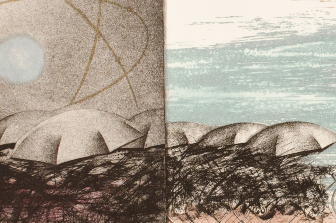
"New Acquisition V"
This is the fifth exhibition of its kind at the Tikotin Museum since re-opening to the public in 1995. Once again, we are proud to present a broad spectrum of artworks donated to or acquired by the Museum during the years that have elapsed since “New Acquisitions VI” in 2014. Traditional and modern prints, clothing accessories and other items are included in this exhibition.
The Museum’s collection has been augmented in various ways over the years. We acquire modern and traditional Japanese works of art, mainly in genres that enrich and sustain the collection, and artworks from new fields as well. Artists exhibiting either solo or in group exhibitions donate their own works to the Museum. Furthermore, some Japanese artists who have yet to be exhibited at the Museum also donate works. The collection has also grown thanks to collectors’ gifts and donations.
Saturday, 22.08.20
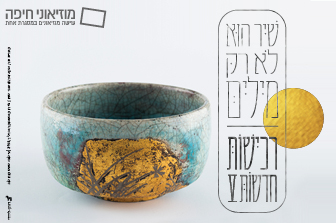
"Poems Are More than Words"
In early ink drawings it was customary to include gasen (writing). Gasen is original prose or verse, or a quotation from classical literature or poetry. In some instances, the text is added by a friend or admirer of the artist, and in others by the artist himself. Beneath the text the signature and seal of the poet are added. During the Edo era (1603-1868), the long tradition of poem-paintings
also began to appear as ukiyo-e (pictures from the floating world),
the woodblock print genre. Although ukiyo-e is considered a
popular art form, it is still closely linked to the classical Japanese
culture. This is evident in the integration of classic tanka poems
in the paintings or prints. An innovation of the Edo period was
illustrating poetry anthologies. The best known of these is "One
Hundred Poems of One Hundred Poets" (Hyakunin isshu).
Saturday, 22.08.20
Please contact us and we will contact you as soon as possible